Creating a ransom note was a fun, creative, and time-consuming process. I came up with as many ideas as possible and repeated this process twice. Even though this took some time, it is crucial to original ideate sentences and creative ideas. Using the magazines, we were limited, but this allowed me to think more outside the box.
When I looked into the magazines, I found out that there were many different themes. My magazines contained a lot of pets, like cats, dogs, and fishes. Besides, I found the boxing gloves and someone holding scissors aggressively. My ransom note had to include pets and a threat. I cut out all different kinds of letters with different colors and put them in several orders. I thought about the size and wanted to give my note a playful vibe.
Moreover, the color is crucial; ransom notes look more beautiful when you use various colors for the letters. The fore and background have to be opposites; otherwise, it is hard to read. It was hard to create a background that was not too busy, because I wanted to have the focus on the pictures of the pets and on the note itself. I figured that all magazines contain everyday articles without distracting colors. By using this, I kept the background of my ransom note calm. I wanted to use this old-fashioned look, but with a small adjustment. So I ripped all articles from the magazines and put them on top of each other. Then I started to cut in diagonal lines. This created fun angular shapes, and because of the way I cut them, they fitted into each other. It is hard to notice this until you look closer and pay more attention to the design. I think it is fascinating how you will see more things if you increase the time you are looking at it.
During this process, you will learn to play with colors, to deal with failure, and to be patient.
Storyboarding is telling a story using simple sketches. Film producers often use this method, they sketch their ideas in squares and add notes. The theme, characters, and setting are revealed, and the vision becomes a reality. It allows them to show their vision to others and ask for feedback at an early stage. It is timesaving, because they can change their script drastically. When creating a storyboard, we have to show our vision instead of adding words. Besides, the perspective is crucial; take a close-up when it is about facial expression. Take a long shot when you want to emphasize someone is lonely and in the middle of nowhere. In short, using different perspectives is key. Moreover, try not to tell a too hard story. Especially when you are a starter, start easy with six squares and try to tell a simple story. Prioritize what the main storyline is and try to express it is as clear as possible. The stories are used for visualization; pictures include color, emotion, and fast readable, which makes it easier to memorize. Telling a story helps people show empathy, they can relate to the story. And it will let people form an opinion about the story; this is engagement.
How do we create a storyboard? We start with brainstorming, come up with as many ideas for stories, there is no right or wrong idea. When you did this for ten minutes, you start over, another ten minutes of brainstorming. Most of the time, people get more creative in this second phase. Pick the five or six best stories; those do not have to be the most complex ones and develop them further. Sketch rough drafts of characters and the surroundings. At this point, you are going to decide which story attracts you the most and is most impressive. Finally, choose the best story, pay attention to different perspectives, and draw it more detailed than the first draft. The storyboard is created, we arrive at the crucial step: feedback. Giving feedback allows you to think critically and to see what mistakes others make. Sometimes it seems logical to us, but they read the story, maybe different. This will remind you to change something, because apparently something is not clear. The stories we can read without explanation are usually the best ones. Just like the design thinking process, are we going back to step one after the feedback to improve the story.
When we reviewed our storyboards in class, we made some common mistakes. Some people tried to tell a complex story in a four-panel story while there was no storyline in others at all. For me, personally, my stories were not creative enough; I could of add a never expected switch in the story. For example, I tried to tell a story about a nervous man marrying a woman, and they lived happily ever after. I could have improved this story by replacing the woman to a man, or the woman answered ‘no’ instead of the expected ‘yes.’ By changing the script, the story gets interesting, and people want to read further, this is the goal of storyboarding.
The final step, but not necessarily the last in the design thinking process, is Test. In this stage, we will give our design to a third person, who has never seen the design before, and this person is going to use the product. In this way, it is easy to find out if the user has trouble, and we will see which problems they are facing. We use our analyses and go back into the design process, whether it is back to the Empathy or Define phase etc.
Testing products is not as easy as it seemed, we as designers depend on the testers. The more comments they leave while testing the product, the more valuable it is. However, there are several reasons for users to give not honest feedback. One big problem for the users is that they do not want to hurt your feelings. When they know you designed the product and put much effort into it, they will give you positive feedback no matter what their opinion is. An easy way to avoid this is by saying you are testing the product for a third party. Now they know they are not directly hurting you, and it is easier for them to be honest. Besides, sometimes the testers think they got tested, they will give different feedback than they would typically provide. When we examine our systems or products, we have to be very clear to the testers, that we are not testing them but the product.
The feedback of users is valuable because sometimes we as users can become blind to the functionality. During the process, we added too many features to the product, and the product became hard to use. The product has to be relevant and letting users test them let us understand the user’s needs better. A design that is not relevant to its target audience will never be a success. The key to designing a relevant product is validating your ideas with users continuously. Ask them during the process what they think of your design, what the essential part of the product is, and what they would change. This will allow you to go in the right direction again and to make early changes.
In our design thinking process, we created a silly, funny app without purpose or relevance. We tested our app by showing them to classmates. They used the app and told us what was going on in their mind. In this way, we as producers saw what the user was experiencing, we saw how they misused some functions and how they preferred some buttons over others. This data was very helpful; it allowed us to go back into the design thinking process and refine the problems. We have to accept that the first time we test something, it is not going to be perfect. There are always things we have to change in the design, and that is okay. Failure makes us better designers; we learn what to do better next time. At the end of observing and thinking of improvements, we start to redesign our app and to remove unnecessary buttons, which made the app more comfortable to use. We can test our product again and see if it’s easier to use now or if it’s still too complicated. We might need to come up with new ideas and start the whole design process again. This can feel defeated, but keep in mind all the time we spend in the design thinking process, will give us valuable experiences and knowledge in becoming a great designer.
The most important part of prototyping is not to think. Sometimes we overthink the problem, and we don’t come up with the simple ideas. We have to start building plans and allow us to make mistakes. We have to remind ourselves that an idea is never invented at one time. By accepting that we can fail, we will gain insights, which we can use to improve our idea. We have to make as many variations as possible so that we can select and reject ideas. In a designing team, every individual has to develop their prototypes. Everyone has other perspectives, and by discussing the prototypes, we can learn from each other.
We have to keep in mind the purpose of the product, as well as the users’ needs and behavior. Sometimes we add too many features to a product that the product becomes too complex. Making a product simple is the key to success. Learn from making prototypes and revisit previous stages. Look back at the earlier stages, like empathy, to see if you are helping the user.
We can divide prototyping methods into two categories: low- and high-fidelity prototyping. Low fidelity has fewer features and only the essential functions. They are used to show the general idea through storyboarding, sketching, and card sorting. It is quick and inexpensive; it gives the producer an overall view in which he still can make changes. The total opposite is high-fidelity prototyping, in which we refine every detail. This takes a lot more time and effort, but the stakeholders can better judge the idea and give feedback. However, making changes in those prototypes is hard because everything is already expanded. We, as designers, prefer using the low-fidelity method in the earlier stages and the high-fidelity prototyping later.
“If a picture is worth a thousand words, then a prototype is worth a thousand meetings.” – Saying at IDEO. Making prototypes allows us to bring more concepts or theories to life and explore their impact before choosing one or two of them. Often design teams want one or two ideas to develop instead of going through the design thinking process. This is mostly because of limits of time or money. Using the low-fidelity method gives us the chance to develop more ideas and choosing the right one.
Prototyping is not only about designing new products; it helps us as designers think in other ways. We learn from other team members’ ideas, and in the next project, we can use this way of thinking. Besides, prototyping can inspire others and ourselves. The process is exciting, and we will learn a lot. We have to be comfortable with the fact that we are going to fail. We have to release and move on, this will speed up the process, and the final product will become better.
The third step in the design thinking process is ideate, coming up with as many ideas as possible. It is about quantity and not about quality; there are no right or wrong ideas. Everyone explains their concepts, and there is no judgment. Mind maps, post its, graphs, tables, and storyboards can be used to gain new insights.
Problem-solving is a skill that everyone has, but the way people solve specific problems is different. In general, people think creativity is an innate skill that you have or do not have and cannot improve. However, everyone is creative in their way, so everyone has this skill when born, and we will develop it further during our life.
Creativity is solving problems based on novelty over relevance. Novelty is the uniqueness and originality of the idea. Relevance is to what extent the problem has really solved or whether it has only partially solved. We often forget that novelty is necessary in coming up with innovative ideas. To come up with these ideas, we have to be open-minded. Think of all possible solutions and write everything down; it is not the intention to eliminate thoughts in this phase.
In a course by Stefan Mumaw, he gives an explanation of how the ideation process works. The process is usually the same; first, they come up with many ideas up to a point where no or hardly any new ideas are invented. Then at a particular end, someone comes up with a weird, silly thought; this will let people think differently. Coming up with ideas is now much more accessible; everyone is now starting to think outside the box. This process is showed in the graph above. The y-axis is the quality and quantity of the ideas, and the x-axis is the amount of time. The leader of the group has only an impact on the amount of time that’s given, and not on the developing of ideas. By extending the time of the second stage, there is a higher chance of better and more ideas. Many companies come up with the same ideas; this is often due to a lack of time; they do not reach the second phase. Besides, they often come up with two or three good ideas. They then work them out ultimately, and they no longer pay attention to the other stupid ideas. The exclusion of ideas may not happen at the ideation stage; the prohibition is always possible. This mistake is still very often made by companies; this results in many obvious same solutions.
Coming up with ideas is only possible if you have self-confidence in your creative thinking. Believe in yourself; there will be moments in the creative process that you do not know so well if there are more kinds of ideas, and you feel lost. Besides, it can sometimes be useful to give up the assignment for a bit and do something that has absolutely nothing to do with the task. Hike a mountain, walk with your dog, listen to music or work out; this ensures that you relax and that your creativity gets a boost afterward. Furthermore, it can help to change the working environment so that you can gain inspiration. The most crucial tip in creative thinking is to have fun during the process. Humor is the key to success.
I think Christoph Niemann is very creative and is using his humor positively; you can see this on his website. He has made an app called Chomp in which he, with simple drawings and a face of a person, can make funny animation. He shows how an app can be displayed in a way everyone could make itself. Niemann is known for his abstract way of working; he makes everything look easy. He defines abstraction as getting rid of everything that is not essential. This makes everything look very simple, some people love it, and others hate it. His job is to design new things, and he often comes into the design thinking process. He is familiar with the fear of starting the process; he emphasizes that everyone has this fear, and that’s a regular thing. A design thinking process is never-ending. Technologies keep innovating, which means that we, as designers, are continually innovating too. Niemann summarizes the constant renewal of ideas as “being done is the opposite of what I am trying to achieve.” With this, he shows that he is open-minded and enjoys solving problems.
One of the best-known inventors of the world, Albert Einstein, says, “creativity is intelligence having fun.” We have received information from the empathy phase and the define phase, by looking at this information in many different ways, we can come up with new creative insights. We have got the intelligence if we stay confident, relax, and enjoy the design process, we will invent new creative ideas!
Solving a problem is often more complicated than we think in advance. There are usually several problems involved, making it challenging to find the right solution. If we only come up with solutions, we always come up with the same kind of solutions, which does not work effectively. We keep reasoning in the same circle all the time because these are easy and safe solutions, and we are afraid to step out of our comfort zone. It is, therefore, convenient to work with two or more persons together because everyone has different thoughts and insights. Someone else looks differently at specific problems, so together, we can come to a better idea.
We can compare problems with clouds. If the weather is dull, several clouds merge into each other, and this is, most of the time, the case with issues too. A bird’s eye view is needed to separate them. Look at the problems, separate them, and define them. After those steps, we will conclude what the overall problem is.
It starts with accepting that the problem exists and that there is a solution but that we do not yet know which solution is the best. By asking questions in the form of “how might we,” we can better define the problem. Questions beginning with words like who, when, what, where, and why are helpful questions because they give us more information about the case. Solutions will soon come up when asking these questions. However, these do not always have to be the best solutions. Don’t rule out ideas; there are no wrong solutions and write down all the possible options so that we don’t forget them. In short, stay open-minded when coming up with solutions. It is useful to make a hypothesis about the best option, for example, can this solution work in these circumstances? After the thesis has been drawn up, we will investigate and assess whether the hypothesis is correct using questions. If the thesis is incorrect, we can still change or adjust it. Then the hypothesis and its correctness are critically examined once more.
By setting the hypothesis and coming up with ideas for solutions, we have discovered the current problem. We have found the causes because we have split the problem into smaller parts. This allows us to choose the best ideas and further develop them. When three or four plans have been worked out, it is time to select the best idea. But how do we know which design works best? We have to think of a lot of factors, which concept would work best in the present? Technology is changing rapidly nowadays, so we have to consider whether it will still be a properly functioning and valuable product in 5 or 10 years. It is difficult to predict what will change in the future. Through looking at previous years and the growth of specific technologies, we can estimate which technology we will have in five years. We have to be more openminded and flexible to changes even when we might not have expected these changes. We have to adapt our designs to this, and not let ourselves be overwhelmed by the changes. We have to make changes in our design as possibilities to make a better product and to learn more as a designer.
I generally think that we should see everything more as opportunities rather than failures. If something goes wrong, it’s okay, as long as you learn from it and try to do better next time. The technology is changing very quickly; it makes sense that we sometimes have ingenious designs that are entirely unnecessary after two years. We have to see the fast movement of technology as a challenge to come up with excellent and longer-term designs to make life better for people, animals, and the environment.
“Empathy is the ability to feel the emotions of others and to imagine what someone else is thinking or feeling” according to the Greater Good Science Center at UC Berkeley. The difference between empathy and sympathy is that sympathy shows compassion and compares its situation with the other. Empathy is to immerse yourself in the feelings of the other without judging. Having empathy is partly congenital; in the first two years of life, those skills will develop further. Humans are not the only ones with natural empathy; primitive animals such as rats also possess it.
Everyone is in a different situation, and it is sometimes difficult to see how someone feels on the outside. By showing empathy, you can help someone by trying to stand in the same shoes as those. Ensure a neutral state of mind, calmly think about what he or she is saying. Hear what they hear, see what they see, and feel what they feel. This way, you get into the situation and experience everything like that, this makes it easier to offer support, and the other person feels understood. After the perspective is taken, it is important not to judge what the person should do. It is better to do not interrupt the speaker and keep listening until the speaker has finished talking. Ask the last questions about the subject to understand the situation better. Look at the speaker’s body language; it tells you a lot of the person’s feelings and emotions. Recognizing the emotion and communicating is essential for forming a connection between each other. This bond will let the person feel more accepted, more relaxed, and reduce negative thoughts. The purpose of empathy is to make the speaker feel understood.
Empathy ensures better relationships, reduces prejudice and racism, and a better atmosphere in the workplace. Bias and racism can be reduced by using empathy skills because it looks at traits that people share instead of splitting. Due to the similarities, thoughts can be changed, and prejudices weakened. The empathy process usually takes place on an individual basis. Nowadays, this empathy is also spread via social media with hashtags, for example, the recent hashtag #prayforAmazonas. The Amazon was struggling with enormous drought, nobody was taking care of the forest, and the drought was not even mentioned in the news. People found out about this disaster and started sharing because they had empathy for the animals and unique plants that only appeared in the Amazon. Because of this action, many people began donating, and the ultimate goal to stop the fire was successful. This is one of many examples of how showing a small group’s empathy can affect a larger group. Having empathy for someone depends on many different factors. For example, if someone is hit by a car and you know him, the empathy is higher than if this happens to a person you don’t know. Besides, the distance makes a difference; if there is a disaster in your environment, people usually find it worse than if the accident takes place very far away. Humanity is, therefore, selective in having empathy. A study looked at the different reactions of Chinese and Caucasian participants. The activity in the part of the brain that demonstrates empathy was less active if the participants observed people from the other ethnic group. This study shows that the amount of empathy also depends on the ethnic group to which someone belongs. In some situations, it is better to have less empathy for a specific group, for example, in wars.
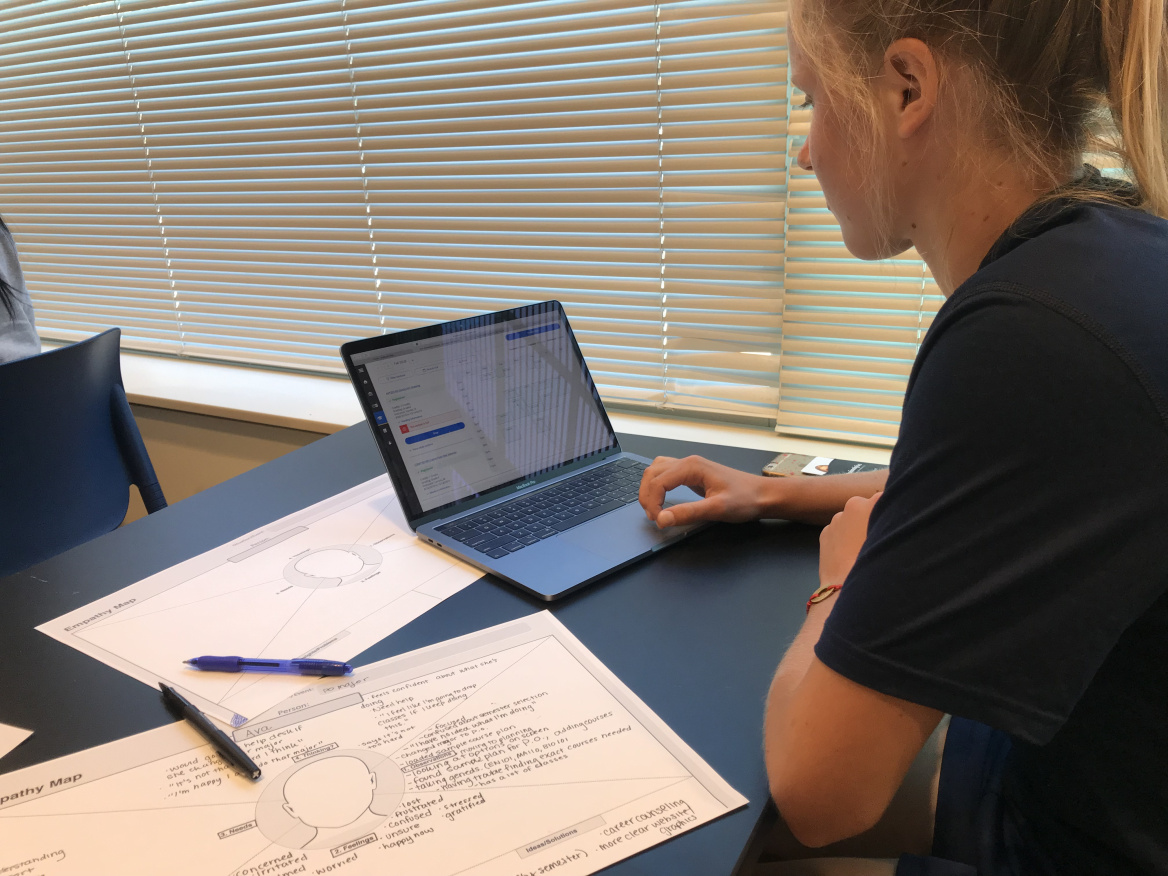
We also discussed empathy in class. All first-year students sat down next to an older year student. The freshman had to change their major to political science by using self-service. The older student had to observe and was allowed to ask questions about feelings and thoughts but couldn’t help or advise the freshman. So, the older years used their empathy skills in this assignment. In the beginning, it was confusing to work with self-service because of its many buttons with different functions. I was perplexed in the beginning, but after a while, I started to understand the program. After I made the roster, we started evaluating the process and thought about what could be improved in the self-service site. We concluded that a tutorial video would be helpful with instructions on how to add and drop classes. The older year students filled in the empathy map with the information the freshmen told them.
In short, the use of empathy is essential to reassure the speaker and to find out what problems the speaker is experiencing.
The first step in the designing process is based on doing a lot of research. We start to look at the main problem and hopefully find out what the causes are because we prefer preventing the problem over solving the problem. If we can not prevent the problem, we as designers have to find a solution to which people have a great advantage. Jesse James Garrett, User experience designer, said: “User-centered design means understanding what your users need, how they think, and how they behave – and incorporating that understanding into every aspect of your process.” Assumptions and prejudices must not influence this part of the process. Listen to others, read articles or books about the subject, and inform yourself. Observe the products made through others and learn from their mistakes.
Define
After all information has been collected, it is merged in this step. The data is analyzed, and the core problem is defined. According to Tim Brown, ‘ Design thinking gives us a new way of tackling issues.’ We encourage thinking differently, we will think of new solutions, and going on in this direction before eliminating the three best ideas and then choose the best one. ‘But before we go through that process of divergence, there is quite an essential first step. And that is, what is the question that we’re trying to answer?‘ Because if we define the wrong question and succeed in answering it, it is a waste of time. Besides, other items are considered that are related to the most crucial issue. What is the cause of the problem? Can we prevent the problem? What makes the problem so complicated? What solutions have we used in the past? And why were these not good as a solution? After all these questions are answered, we have gathered more information, which makes it even easier to understand the issue and the context.
Ideate
Once the problem has been analyzed and defined, the next step is ideate. As many ideas as possible are devised, there is no right or wrong idea. It is necessary to think outside the box; it is about thinking about what you have not thought about before. Everyone can give feedback. It is about quantity instead of quality. First, as many ideas as possible are thought up by everyone, and then the ideas are compared, and the best idea is chosen.
A final test is needed to bring a successful product to the market. The product is made and tested in a small amount; a small group of people will use the product and give the designers a look in their mind by telling them exactly what they think. This feedback is essential to the designer, and needs to be honest. The Design Thinking process is not linear and never ends, so this final version is again critically examined. The problem is defined more precisely than in the first instance, and the solution is adjusted accordingly. Because all steps are repeated more often, much can be learned when creating a product. This ensures that you gain more experience and that the process runs smoother next time. Failure makes us better; we have to learn by looking at our mistakes. But we do not want to become insecure, it is okay to fail, and we have to accept that, without failure, your product is never going to be the best version of itself. “Fail often so you can succeed sooner,” said Tom Kelley, Author and General Manager, IDEO.
To make a long story short, the design thinking process consists of five steps: Empathize, Define, Ideate, Prototype, and Test. After the users’ feedback, we will go back to one of the phases; this can be any phase. Before I learned this, I thought the process would go much smoother, but it turns out that even the best designers have trouble with defining the right question and coming up with solutions that work.